
A message bus system that provides a simple way for applications to talk to one another. #Message bus #Interprocess communication #Message bus system #Dbus #Message #Bus
D-Bus is an open source and free command-line software implemented in C, a non-interactive daemon that acts as a message bus system. It is heavily used in modern Linux distributions to allow applications to talk to one another.
This message bus system has been engineered in such a way that helps you coordinate process lifecycle, by making it reliable and simple to write a daemon or a "single instance" application.
The project is comprised of a system daemon that takes care of events like "printer queue changed" or "new hardware device added," and a per-user-login-session daemon, which is mostly used for general IPC tasks.
Various re-implementations of the D-Bus protocol were created during the past several years, for languages like Java, Ruby, and C#. However, they don't use the libdbus reference implementation.
The software is written entirely in the C programming language. To install and use it in your GNU/Linux operating system, you must first download the latest source code from Softpedia, where it’s distributed as a tar archive, save it on your computer and extract its contents.
Open a terminal emulator, using the ‘cd’ command navigate to the location of the extracted archive files, and run the ‘make’ command to compile the source code. Then, use the ‘make install’ command, as root or with sudo in front of it, to install D-Bus system wide.
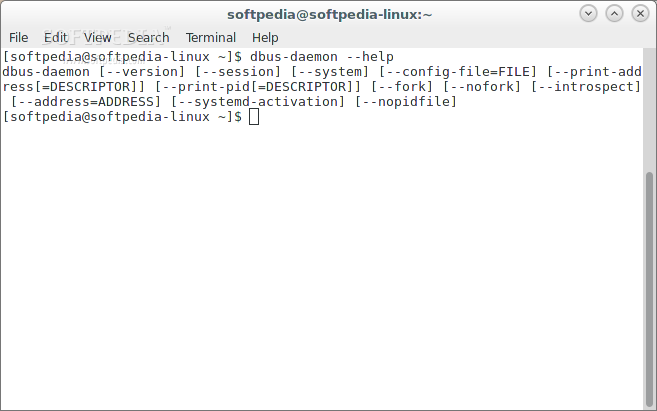
Running the ‘dbus-daemon --help’ command will display the program’s command-line options at a glance. Among these, we can mention support for specifying a configuration file, support for systemd, the ability to run it without a PID file, as well as fork and nofork support.
D-Bus 1.9.2
add to watchlist add to download basket send us an update REPORT- runs on:
- Linux
- filename:
- dbus-1.9.2.tar.gz
- main category:
- Utilities
- developer:
- visit homepage
7-Zip 23.01 / 24.04 Beta
Zoom Client 6.0.3.37634
4k Video Downloader 1.5.3.0080 Plus / 4.30.0.5655
ShareX 16.0.1
calibre 7.9.0
IrfanView 4.67
Bitdefender Antivirus Free 27.0.35.146

Context Menu Manager 3.3.3.1
Windows Sandbox Launcher 1.0.0
Microsoft Teams 24060.3102.2733.5911 Home / 1.7.00.7956 Work
- Context Menu Manager
- Windows Sandbox Launcher
- Microsoft Teams
- 7-Zip
- Zoom Client
- 4k Video Downloader
- ShareX
- calibre
- IrfanView
- Bitdefender Antivirus Free
