
An Open Source tool that provides a diskless or systemless environment for client machines. #Diskless remote boot #Remote boot #Linux shell #Diskless #Remote #Boot
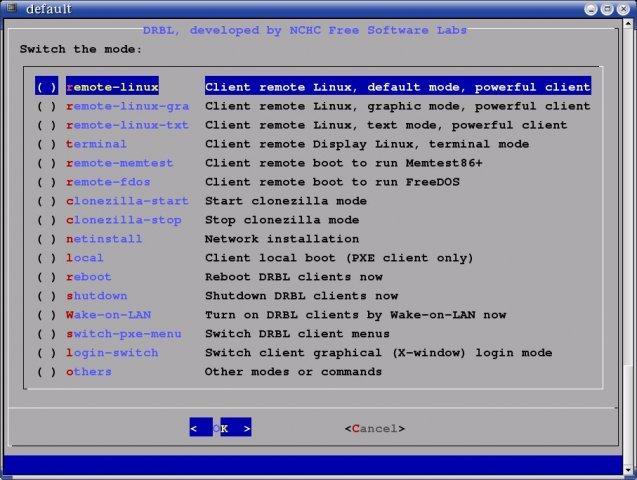
DRBL (Diskless Remote Boot in Linux) is an open source, totally free and multiplatform command-line software implemented in C, Perl and UNIX Shell, and designed to provide an environment for effortlessly managing GNU/Linux and BSD operating system deployment.
With DRBL, users will be able to install just one server machine and quickly configure as many client computers as they want in no time, with minimum effort and using the latest PXE/Etherboot, NIS and NFS technologies.
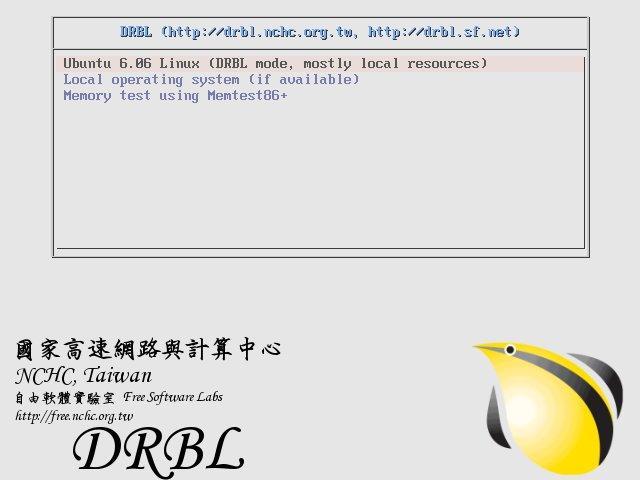
It presents users with a DOS-like menu, from where they can boot a remote Linux system, run the FreeDOS operating system, perform a memory diagnostic test using the Memtest86+ utility, clone disks, or boot via PXE (Preboot Execution Environment).
The powerful and popular Clonezilla disk cloning/imaging software is also included in the DRBL project, allowing the user to clone disk partitions or entire drives without too much hassle. More details about Clonezilla and the Clonezilla Live CD can be found on the Linux section of Softpedia.
Being also available as a Live CD Linux operating system, using the powerful and popular Clonezilla software, DRBL provides the ability to access local hardware by using distributed hardware resources.
As mentioned at the beginning of the description, the C, Perl and UNIX Shell programming/scripting languages were used to write the source code for DRBL (Diskless Remote Boot in Linux), which is supported on all GNU/Linux distributions, as well as on the FreeBSD operating system.
For your convenience, the program is distributed as native installers for Debian/Ubuntu and Red Hat/Fedora based distributions of Linux in the RPM and DEB file formats, supporting both 64-bit and 32-bit computer architectures. The source code is available for download as a compressed archive (tarball) or a SRPM package.
DRBL 2.8.25
add to watchlist add to download basket send us an update REPORT- runs on:
- Linux
- main category:
- System
- developer:
- visit homepage
Microsoft Teams 24060.3102.2733.5911 Home / 1.7.00.7956 Work
4k Video Downloader 1.5.3.0080 Plus / 4.30.0.5655
ShareX 16.0.1
calibre 7.9.0
Windows Sandbox Launcher 1.0.0
IrfanView 4.67
Zoom Client 6.0.3.37634
Bitdefender Antivirus Free 27.0.35.146
7-Zip 23.01 / 24.04 Beta
Context Menu Manager 3.3.3.1
- Bitdefender Antivirus Free
- 7-Zip
- Context Menu Manager
- Microsoft Teams
- 4k Video Downloader
- ShareX
- calibre
- Windows Sandbox Launcher
- IrfanView
- Zoom Client