
An Open Source, free, cross-platform, feature-rich, high-performance RADIUS server. #RADIUS server #Apache module #PAM library #RADIUS #Server #Apache
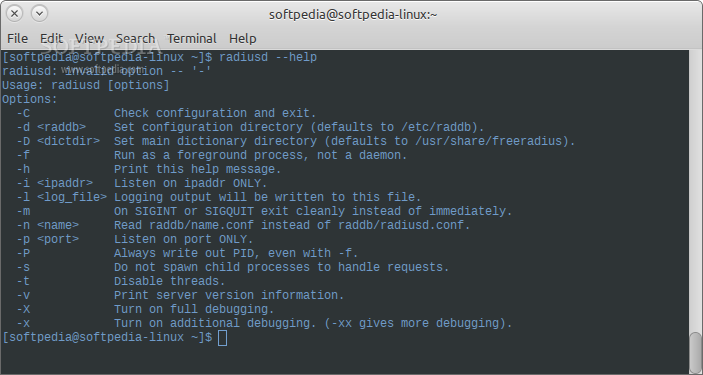
FreeRADIUS is an open source command-line application that provides users with a unique and full featured Remote Authentication Dial In User Service (RADIUS) server for the Linux, BSD, Microsoft Windows and Mac OS X platforms.
The project is comprised of the actual RADIUS server, a client library, a module for the Apache web server, as well as a PAM (Pluggable Authentication Module) library. It is available for download as a source archive, enabling users to configure, compile and install the program on any Linux distribution.
It is a fast, flexible and fully configurable RADIUS server that supports more authentication protocols than any other commercial or free product. It features support for LDAP, MySQL, PostgreSQL and Oracle databases.
Supported authentication methods include PAP, MS-CHAP, MS-CHAPv2, CHAP, and SIP Digest. It supports EAP, with EAP-SIM, EAP-MD5, EAP-TTLS, EAP-TLS, EAP-PEAP, as well as Cisco LEAP sub-types.
It has a modular design that will allow experienced users to deploy it on embedded systems. All requests can be proxied, supports standard RADIUS realms through simple configurations, and virtual servers. It has been tested and can be used with a plethora of 802.1x supplicants, servers and clients.
Another interesting feature is the ability to assign VLANs (Virtual Local Area Networks) via the VMPS (VLAN Management Policy Server) protocol. It also comes with built-in DHCP implementation for IP address assignments.
By default, the application supports all RADIUS RFC's and attribute definitions, and it’s compliant with numerous specifications, including RFC1157, RFC2868, RFC1448, RFC3748, RFC5080, RFC2865, RFC2289, RFC4372, RFC2882, RFC2866, RFC4675, RFC4679, and RFC2621.
Overall, FreeRADIUS proves to be one of the fastest and scalable RADIUS servers for Linux-based operating system. It’s also a very stable and reliable product that runs on Cygwin, Mac OS X, DragonFlyBSD, FreeBSD, NetBSD, OpenBSD, Solaris, and Windows platforms.
What's new in FreeRADIUS 3.0.20:
- The focus of this release is stability.
FreeRADIUS 3.0.20
add to watchlist add to download basket send us an update REPORT- runs on:
- Linux
- filename:
- freeradius-server-3.0.20.tar.gz
- main category:
- System
- developer:
- visit homepage
paint.net 5.0.13 (5.13.8830.42291)
Zoom Client 6.0.0.37205
Windows Sandbox Launcher 1.0.0
ShareX 16.0.1
IrfanView 4.67
Bitdefender Antivirus Free 27.0.35.146

4k Video Downloader 1.5.3.0080 Plus / 4.30.0.5655

Microsoft Teams 24060.3102.2733.5911 Home / 1.7.00.7956 Work
7-Zip 23.01 / 24.04 Beta
calibre 7.9.0
- Microsoft Teams
- 7-Zip
- calibre
- paint.net
- Zoom Client
- Windows Sandbox Launcher
- ShareX
- IrfanView
- Bitdefender Antivirus Free
- 4k Video Downloader