
A command-line and very fast processor emulator for Linux-based operating systems #Processor emulator #Virtualization software #Virtual machine #Virtualizer #Processor #Emulator
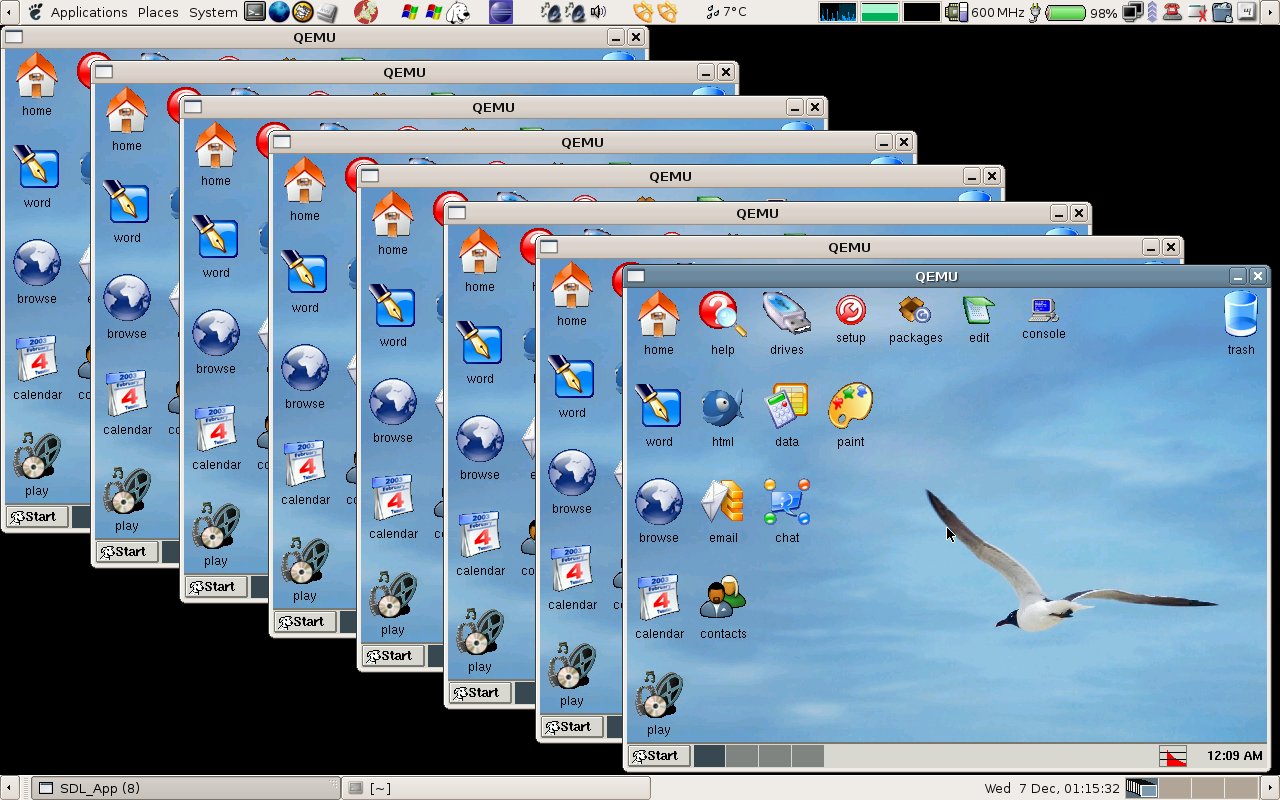
QEMU is an open source and very fast virtualization software that focuses on dynamic translation to achieve reasonable performance, while being easy to port to new host CPUs (processors).
It is also known as a machine emulator, engineered to emulate a full system, including a processor and its peripherals. The emulation part supports operating systems and programs created for a single hardware platform, but running on top of a different computer with a different architecture.
On the other hand, when the application is used as a virtualizer, it can achieve almost native performances by running the guest code straight on the host processor. It supports the Xen hypervisor and the KVM (Kernel Virtual Machine) kernel module.
If KVM is preferred, the application will be able to virtualize x86 (32-bit), s390, PowerPC, ARM, m68k, MIPS, CRIS, Microblaze, MIPSEL, or32, and SPARC machines. It can emulate the Windows XP, FreeDOS and SunOS systems, as well as Virtio, USB Root Hubs, networking, input, video and storage devices.
After VirtualBox and VMware, QEMU is the third biggest virtualization software for Linux platforms, but the first and most powerful one for the open source ecosystem. Its key feature is the ability to run as a native virtual machine on 64-bit or 32-bit architectures, or as a pure emulator.
It is a command-line software and runs on Linux-based operating systems, as well as Microsoft Windows and various UNIX flavors. A source archive is provided on the dedicated download section, allowing users to configure, compile and installed the program in any Linux distribution, as well as on OpenBSD, Solaris, AIX, MinGW, and Cygwin systems.
Whether you want to test software, try various operating systems, or just run applications that are not supported on your platform, QEMU provides users with one of the fastest virtualization and emulator machine.
QEMU 4.2.0
add to watchlist add to download basket send us an update REPORT- runs on:
- Linux
- main category:
- System
- developer:
- visit homepage
Bitdefender Antivirus Free 27.0.35.146

Zoom Client 6.0.4.38135
7-Zip 23.01 / 24.04 Beta
Windows Sandbox Launcher 1.0.0
calibre 7.9.0

Context Menu Manager 3.3.3.1
Microsoft Teams 24060.3102.2733.5911 Home / 1.7.00.7956 Work
IrfanView 4.67

ShareX 16.0.1
4k Video Downloader 1.5.3.0080 Plus / 4.30.0.5655

- IrfanView
- ShareX
- 4k Video Downloader
- Bitdefender Antivirus Free
- Zoom Client
- 7-Zip
- Windows Sandbox Launcher
- calibre
- Context Menu Manager
- Microsoft Teams