
A lightweight intrusion detection system and intrusion prevention system for GNU/Linux systems. #Intrusion detection #Security software #Detection technology #Snort #Intrusion #Detection
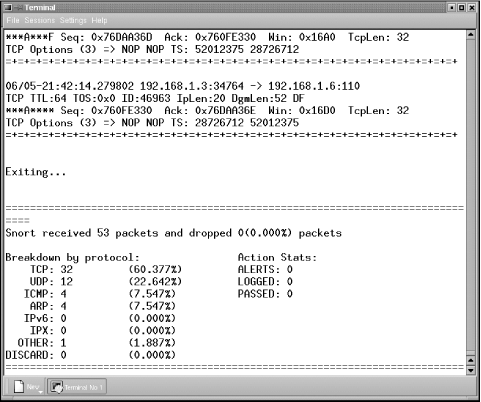
Downloaded by millions of people worldwide, and with over half a million registered users, Snort is an open source and free command-line application that can be successfully used for network intrusion prevention, detection and protection on any GNU/Linux operating system, capable of packet logging and real-time traffic analysis.
The project can be configured in four modes, Sniffer mode, Packet Logger mode, Network Intrusion Detection System (NIDS) mode, as well as the Inline mode. Snort comes with predefined rules that can be downloaded from the project’s website, created by the community or by the Snort developers.
Despite the fact that it runs from the command-line, Snort isn't very hard to use, but there are a lot of options for you to play with. It successfully combines the benefits of anomaly-based inspection, signature and protocol, making it the most widely deployed IPS (Intrusion Prevention System) and IDS (Intrusion Detection System) technology.
As it’s available for download as a universal sources archive, Snort is officially supported under numerous GNU/Linux distributions, but it officially supports, with binary packages, the Fedora, CentOS, FreeBSD and Microsoft Windows operating systems. Both 32-bit and 64-bit architectures are supported at this time.
Snort can be easily installed on numerous GNU/Linux flavors, as it is available for download from the default software repositories of popular Linux kernel-based operating systems. Gettings started documentation can be found on the project’s page, covering a vast amount of questions related on how to setup Snort on Debian, openSUSE, Fedora, CentOS, FreeBSD and NetBSD OSes.
Snort 2.9.15.1
add to watchlist add to download basket send us an update REPORT- runs on:
- Linux
- main category:
- Security
- developer:
- visit homepage
7-Zip 23.01 / 24.04 Beta
ShareX 16.0.1
calibre 7.9.0
IrfanView 4.67

4k Video Downloader 1.5.3.0080 Plus / 4.30.0.5655

Windows Sandbox Launcher 1.0.0
Zoom Client 6.0.3.37634

Bitdefender Antivirus Free 27.0.35.146
Context Menu Manager 3.3.3.1
Microsoft Teams 24060.3102.2733.5911 Home / 1.7.00.7956 Work
- Bitdefender Antivirus Free
- Context Menu Manager
- Microsoft Teams
- 7-Zip
- ShareX
- calibre
- IrfanView
- 4k Video Downloader
- Windows Sandbox Launcher
- Zoom Client