
A fast, Open Source and cross-platform lexical analyzer and scanner generator tool #Lexical analyzer #Scanner generator #Generate scanner #Lexical #Analyzer #Scanner
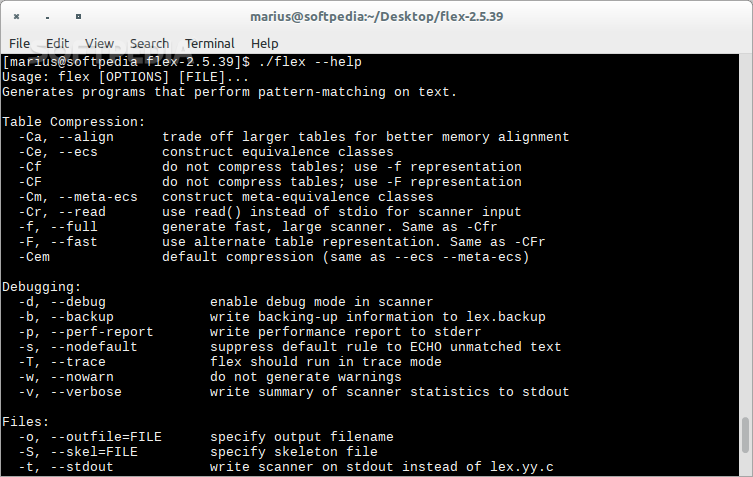
Flex is widely known as the fast lexical analyser and it’s an open source, totally free and multi-platform command-line application implemented in C/C++ and designed from the offset to be used for generating scanners.
The scanners generated by the Flex tool, which shouldn’t be confused with a non-GNU free implementation of Lex, are actually programs that can recognize lexical patterns in text, also known as applications that perform pattern-matching on text.
Flex has been designed in such a way that it can generate a C source file called "lex.yy.c" which can define the yylex() function. The software is a command-line tool, so you can use it via any terminal emulator.
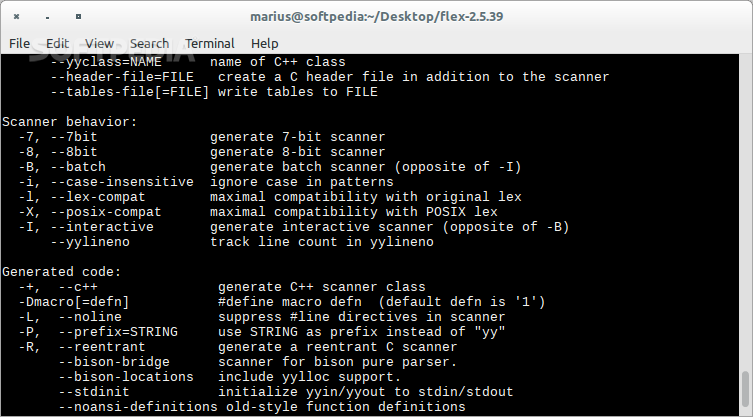
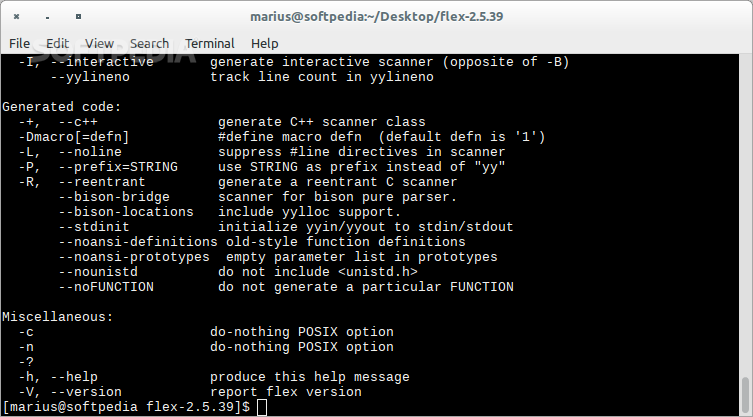
The program’s command-line options are organized in categories like table compression, debugging, files, scanner behavior, generated code and miscellaneous. To see them at a glance, run the ‘flex --help’ command after installing the software on your system.
Among the table compression command-line options, we can mention the ability to construct equivalence and/or meta-equivalence classes, to use an alternate table representation, to use default compression, to generate a large and fast scanner, as well as to not compress tables.
Debugging command-line options include support for enabling debug mode in scanner, support for writing summary of scanner statistics to stdout, support for running Flex in trace mode, as well as support for writing backing-up information to a specific file and a performance report to stderr.
The scanner behavior can also be customized via command-line options, which include support for generating 7-bit or 8-bit scanners, support for generating a batch scanner, support for generating an interactive scanner, as well as support for tracking line count in yylineno.
The software has been written entirely in the C and C++ programming language and it is known to work well on both Linux and FreeBSD operating systems. Currently, it can be installed on computers supporting either of the 64-bit or 32-bit instruction set architectures.
What's new in Flex 2.6.4:
- build:
- The indent target now knows about flex's new (as of 2.6.0) layout. The indent rules it would apply are not correct and do need to be fixed.
- The files included in the flex distribution are now built by the version of flex that is included in the distribution.
- The configure script has a better idea of which headers are required to build flex. It will also error when missing functions are detected.
Flex 2.6.4
add to watchlist add to download basket send us an update REPORT- runs on:
- Linux
- filename:
- flex-2.6.4.tar.gz
- main category:
- Programming
- developer:
- visit homepage
Zoom Client 6.0.4.38135
ShareX 16.0.1
Microsoft Teams 24060.3102.2733.5911 Home / 1.7.00.10152 Work
4k Video Downloader 1.6.0.0085 Plus / 4.30.0.5655
IrfanView 4.67
Windows Sandbox Launcher 1.0.0
Context Menu Manager 3.3.3.1
Bitdefender Antivirus Free 27.0.35.146

calibre 7.10.0
7-Zip 23.01 / 24.04 Beta
- Bitdefender Antivirus Free
- calibre
- 7-Zip
- Zoom Client
- ShareX
- Microsoft Teams
- 4k Video Downloader
- IrfanView
- Windows Sandbox Launcher
- Context Menu Manager