LINUX CATEGORIES:
NEWS ARCHIVE >>
SOFTPEDIA REVIEWS >>
|
|
7-DAY TOP DOWNLOAD
# |
Program |
 | Mandriva Linux 2008.1 / 2009 RC1 256,466 |  | Fedora 9 / 10 Alpha 216,693 |  | KNOPPIX Live DVD 5.3.1 210,142 |  | Kororaa AIGLXgl Live CD 0.3 180,534 |  | Beryl 0.2.1 178,807 |  | BackTrack 3.0 172,077 |  | MPlayer 1.0 RC2 158,304 |  | aircrack 2.41 158,233 |  | VLC 0.9.0 113,355 |  | Cedega 6.0 108,135 |
|
WEEK'S BEST
Softpedia Linux RS...Ubuntu 8.04.1Pidgin 2.5.1Adobe Flash Player...The Gimp 2.4.7 / 2...openSUSE Linux 11....Linux Kernel 2.6.2...Super Grub Disk 0....Skype 2.0.068OpenOffice.org 2.4...Mozilla Firefox 3....Transmission 1.33DeVeDe 3.11bWine 1.1.4wine-doors 0.1.2Shoreline Firewall...Linux Mint 5.0Google Gadgets 0.1...Fedora 9 / 10 AlphaOpera 9.52 |
|
|
|
Privoxy 3.0.8 / 3.0.9 Beta
|
|
|
|
|
|
User Rating: Rated by: |
Good (3.8/5) 37 user(s) |
|
|
|
Privoxy description |
|
|
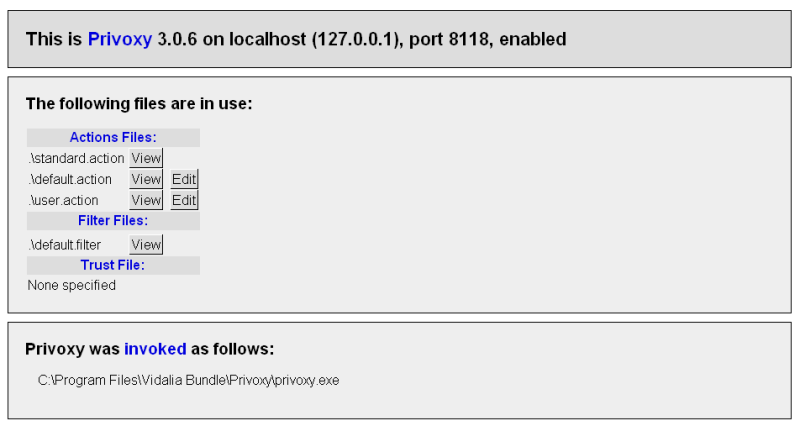
Privoxy is a web proxy with advanced filtering capabilities for protecting privacy. Privoxy is a web proxy with advanced filtering capabilities for protecting privacy, modifying web page content, managing cookies, controlling access, and removing ads, banners, pop-ups and other obnoxious Internet junk.
Privoxy has a very flexible configuration and can be customized to suit individual needs and tastes. Privoxy has application for both stand-alone systems and multi-user networks.
Privoxy is based on Internet Junkbuster.
Here are some key features of "Privoxy":
· Integrated browser based configuration and control utility at http://config.privoxy.org/ (shortcut: http://p.p/). Browser-based tracing of rule and filter effects. Remote toggling. · Web page content filtering (removes banners based on size, invisible "web-bugs", JavaScript and HTML annoyances, pop-up windows, etc.) · Modularized configuration that allows for standard settings and user settings to reside in separate files, so that installing updated actions files won't overwrite individual user settings. · HTTP/1.1 compliant (but not all optional 1.1 features are supported). · Support for Perl Compatible Regular Expressions in the configuration files, and generally a more sophisticated and flexible configuration syntax over previous versions. · Improved cookie management features (e.g. session based cookies). · GIF de-animation. · Bypass many click-tracking scripts (avoids script redirection). · Multi-threaded (POSIX and native threads). · User-customizable HTML templates for all proxy-generated pages (e.g. "blocked" page). · Auto-detection and re-reading of config file changes. · Improved signal handling, and a true daemon mode (Unix). · Every feature now controllable on a per-site or per-location basis, configuration more powerful and versatile over-all. · Many smaller new features added, limitations and bugs removed, and security holes fixed.
What's New in 3.0.8 Stable Release:
- Fixed a small memory leak when listen-address only specifies the port. - The source tar balls now include Privoxy-Regression-Test which (upon other things) can be used to automatically detect some packaging problems. Packagers are welcome to give it a try. - Reverted a change in 3.0.7 that caused path patterns to be checked even if the host pattern match already failed. While this doesn't noticeable affect the performance, it makes it less likely to run out of stack space with overly-complex path patterns the user might have added. - Updated the msn, yahoo and google filters to work as advertised again. - The warning message shown by the show-status CGI page is easier to understand. Previously it wasn't clear that the error message is shown below the invalid directive. (Reported by Lee) - When regenerating Content-Disposition headers the more common spelling is used for the name. Previously it was written without caps. - Less confusing log message if the content type isn't overwritten because force-text-type wasn't used but the old type doesn't look like content that would be filtered normally. - Better log messages if the user tries to execute filters that don't exist. - Treat the non-standard Request-Range headers like standard range headers and suppress them if content filtering is enabled. - Fix build on OS/2 and other platforms that are neither Windows nor Unix based. - Prevent the log messages for CONNECT requests to unacceptable ports from printing the limit-connect argument as [null] if limit-connect hasn't been explicitly enabled. - Don't disable the mingw32 log window if the logfile directive isn't used. While it was an intentional change in 3.0.7 at least one user perceived it as a regression and the same effect can be achieved by disabling all debug directives. - Fixed two minor problems related to the win32 build process: a css file was not being in the installer and the trustfile comment in the config.txt referenced a nonexisting file - Minor documentation fixes.
What's New in 3.0.9 Beta Development Release:
- Added SOCKS5 support (with address resolution done by the SOCKS5 server). Patch provided by Eric M. Hopper. - The "blocked" CGI pages include a block reason that was provided as argument to the last-applying block action. - If enable-edit-actions is disabled (the default since 3.0.7 beta) the show-status page hides the edit buttons and explains why. Previously the user would get the "this feature has been disabled" message after using the edit button. - Forbidden CONNECT requests are treated like blocks by default. The now-pointless treat-forbidden-connects-like-blocks action has been removed. - Not enabling limit-connect now allows CONNECT requests to all ports. In previous versions it would only allow CONNECT requests to port 443. Use limit-connect{443} if you think you need the old default behaviour. - The CGI editor gets turned off after three edit requests with invalid file modification timestamps. This makes life harder for attackers who can leverage browser bugs to send fake Referers and intend to brute-force edit URLs. - Action settings for multiple patterns in the same section are shared in memory. As a result these sections take up less space (and are loaded slightly faster). Problem reported by Franz Schwartau. - Linear white space in HTTP headers will be normalized to single spaces before parsing the header's content, headers split across multiple lines get merged first. This should prevent problems like: * letting the session-cookies-only action slip some Cookies through unmodified, * only suppressing the first line of a header, thus creating an invalid one, and * to incorrectly block headers with valid timestamps that weren't properly recognized. Headers that could trigger these problems are unlikely to appear in "normal" web traffic, but could be intentionally generated to fool some of Privoxy's header parsers. - Host information is gathered outside the main thread so it's less likely to delay other incoming connections if the host is misconfigured. - New config option "hostname" to use a hostname other than the one returned by the operating system. Useful to speed-up responses for CGI requests on misconfigured systems. Requested by Max Khon. - The CGI editor supports the "disable all filters of this type" directives "-client-header-filter", "-server-header-filter", "-client-header-tagger" and "-server-header-tagger". - Fixed false-positives with the link-by-url filter and URLs that contain the pattern "/jump/". - The less-download-windows filter no longer messes "Content-Type: application/x-shockwave-flash" headers up. - In the show-url-info page's "Final results" section active and inactive actions are listed separately. Patch provided by Lee. - The GNUmakefile supports the DESTDIR variable. Patch for the install target submitted by Radoslaw Zielinski. - Embedding the content of configuration files in the show-status page is significantly faster now. For a largish action file (1 MB) a speedup of about 2450 times has been measured. This is mostly interesting if you are using large action files or regularly use Privoxy-Regression-Test while running Privoxy through Valgrind, for stock configuration files it doesn't really matter. - If zlib support is unavailable and there are content filters active but the prevent-compression action is disabled, the show-url-info page includes a warning that compression might prevent filtering. - The show-url-info page provides an OpenSearch Description that allows to access the page through browser search plugins. - Custom client-header filters that rewrite the request line incorrectly no longer cause Privoxy to crash. Reported by din_a4. - The obsolete kill-popups action has been removed as the PCRS-based popup filters can do the same and are slightly less unreliable. - The inspect-jpegs action has been removed. - The send-wafer and send-vanilla-wafer actions have been removed. They weren't particular useful and their behaviour could be emulated with add-header anyway. - Privoxy-Regression-Test has been significantly improved. - Most sections in the default.action file contain tests for Privoxy-Regression-Test to verify that they are working as intended. - Parts of Privoxy have been refactored to increase maintainability. - Building with zlib (if available) is done by default.
|
|
|
|
| Mobile Web Proxy 1.1 |
| Mobile Web Proxy is a (CGI) tool to make more Web pages available from some mobile devices (cell phone Web browsers, etc.). |
|
|
|
| SwiftSurf 1.2.5 |
| SwiftSurf is a web proxy that can handle http (1.0 and 1.1) and https. |
|
| Cntlm 0.35 |
| Cntlm is an authenticating HTTP proxy intended to help you break free from the chains of the proprietary world... |
|
|
|
|
|
|
|
| rtspd 2.0 |
| rtspd is a RTSP Proxy Reference Implementation for UNIX. |
|
|
|
|
|
| Wandora 2008-08-28 |
| A general purpose knowledge management, extraction, and publishing environment based on Topic Maps. |
|
| Delta3D 2.1.0 |
| A full-function game engine appropriate for a wide variety of modeling & simulation applications. |
|
| Genyris 337 |
| A new language inspired by the Semantic Web. |
|
|
|
| BOSS 3.0 |
| BOSS (Bharat Operating System Solutions) GNU/Linux is a Linux distribution developed by C-DAC. |
|
|
|
|
|
|