
An Open Source and free ORM (Object Relational Manager) application written in Python. #Object Relational Manager #Object interface #SQL object #ORM #Object #Relational
SQLObject is a widely used, freely distributed and open source ORM (Object Relational Manager), also known as database wrapper, implemented in Python and designed to be used as an object interface to a database, with tables as classes, columns as attributes and rows as instances.
The software comes with a Python-object-based query language, which will be used by develoopers to provide considerable database independence to all applications, as well as to make SQL more abstract.
Another interesting feature of the SQLObject project, is that it supports all major database servers and database engines, including the well known MySQL, PostgreSQL, Firebird, SQLite, Microsoft SQL Server, MaxDB (SAPDB), and Sybase. It is compatible with both Python 2.6 or 2.7 programming languages.
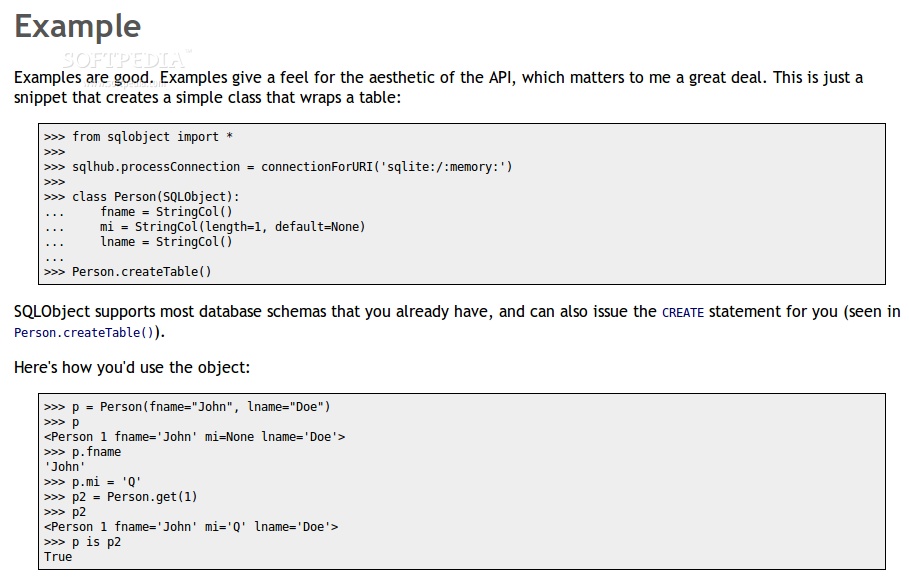
The following lines of code will show Python/SQL developers who the SQLObject software works...
>>> from sqlobject import * >>> >>> sqlhub.processConnection = connectionForURI('sqlite:/:memory:') >>> >>> class Person(SQLObject): ... fname = StringCol() ... mi = StringCol(length=1, default=None) ... lname = StringCol() ... >>> Person.createTable()
...as well as how you should use the object...
>>> p = Person(fname="John", lname="Doe") >>> p >>> p.fname
'John' >>> p.mi = 'Q' >>> p2 = Person.get(1) >>> p2 >>> p is p2
True
Being written in Python, SQLObject is cross-platform, supported on all operating systems where Python 2.6 and Python 2.7 are available, including all GNU/Linux distributions, as well as the Microsoft Windows and Mac OS X OSes.
It easy easily installable from either its source package, using the ‘sudo python setup.py install’ command in the root folder, or easy_install, using the ‘easy_install -U SQLObject’ command, in a terminal emulator application.
The software has been successfully tested with computers supporting either of the 32 or 64-bit instruction set architectures. For more details, please check its official website (see the homepage link below).
SQLObject 3.0.0
add to watchlist add to download basket send us an update REPORT- runs on:
- Linux
- main category:
- Database
- developer:
- visit homepage
Windows Sandbox Launcher 1.0.0
calibre 7.9.0
Zoom Client 6.0.0.37205

IrfanView 4.67

Bitdefender Antivirus Free 27.0.35.146

4k Video Downloader 1.5.3.0080 Plus / 4.30.0.5655

ShareX 16.0.1
7-Zip 23.01 / 24.04 Beta
Microsoft Teams 24060.3102.2733.5911 Home / 1.7.00.7956 Work
paint.net 5.0.13 (5.13.8830.42291)

- 7-Zip
- Microsoft Teams
- paint.net
- Windows Sandbox Launcher
- calibre
- Zoom Client
- IrfanView
- Bitdefender Antivirus Free
- 4k Video Downloader
- ShareX